![[personal profile]](https://www.dreamwidth.org/img/silk/identity/user.png) about_faces
about_faces“The joy of The Dark Knight movie is, ‘This is what a Joker story should be like.’ No one wants to see the ultimate Two-Face movie.”
—Neil Gaiman, from a July 2009 interview with Wired.com.
... Sighhhh.
As you can imagine, that's a quote which has stuck in my craw for two years now. Mainly because I’m still not sure if Gaiman is ignorantly wrong, or simply speaking a brutal truth.
Look, god knows that *I* wanted (and still want) to see that movie, and I'm sure many/most of you would too, by simple virtue that you're reading this blog. By the way, I appreciate that If it weren't for your readership, comments, and discussion, I would have given up on this long ago. Hell, I certainly wouldn't have started About_Faces in the first place if I hadn't thought that Harvey was severely lacking in terms of having a devoted fandom.
Maybe that's all the more reason why Gaiman's words sting, and make me feel defeated as someone who loves the character on a deeply personal level as a fan, not just as someone who's been writing his own epic Harvey Dent origin whatever dealie. Maybe Gaiman's right in that most fans don't actively want to see the "ultimate Two-Face" movie (or comic, or animated episode, or novel, or whatever), but so what? That doesn't negate the fact that Harvey is a great character, even if so many of his stories are subpar.
When it comes to the Big Two comics, I've always maintained that There Are No Bad Characters, Just Bad Writers. While Harvey may be a rather difficult character to write well (for reasons which I explored in an earlier post after reading Chris Sims' thoughtful take on Harvey), he's still a character who endures by his iconic look alone, with the added bonus factors like the coin-flipping gimmick and his tragic origin. Even if Two-Face isn't a popularly-loved figure, he's still popularly-known.
For that alone, he transcends his own stories in the minds of fans and creators, and thus, I'd argue that they'd at least be open and receptive to an "ultimate Two-Face story" which takes the Harvey Dent they already know and spins him in a whole new light, while still holding true to the core of the character. Hell, we've already seen that happen with stories like Eye of the Beholder, Batman: The Animated Series, The Long Halloween, and The Dark Knight, all of which have proven to be definitive takes on Two-Face for certain fans, who judge all other appearances by those core stories.
In fact, Gaiman actually describes exactly what I'm talking about in the full context of the quote:
"The great thing about Batman and Superman, in truth, is that they are literally transcendent. They are better than most of the stories they are in. That’s jut Sturgeon’s Law: '90 percent of everything is crap.' Can you imagine how many thousands, or millions, of words have been written on Batman? Try to read them and you’re looking at 100,000 pages, perhaps a million, and you can assume that 90 percent of it is crap. Yet the 10 percent, and even better the 1 percent of that 10 perfect, is absolutely glorious. That pays for everything...
... it’s something that is missed when they’re made into movies. Marvel Comics has been much more successful than DC Comics, although DC got it right with The Dark Knight. With movies, you want that transcendent 10 percent, that mythology. The Iron Man movie fascinated me. It took a character [at the top of Marvel Comics'] second division, and did him right, so right that everyone goes, "This is why we love Iron Man." The joy of The Dark Knight movie is, 'This is what a Joker story should be like.' No one wants to see the ultimate Two-Face movie."
Reading that whole thing, I guess what really annoys me is that I'm not sure what he really means. What does Two-Face--and the lack of interest for him--have to do with Gaiman's point? How does it illustrate what he's saying? Maybe I'm not accurately or proportionately responding to what was just an off-handed comment by Gaiman, but regardless of what he meant, it's been bugging the hell out of me for years now. I'm just glad to finally have this community where I can figure out WHY it's bugged me so much with other people who'll actually CARE.
But eh, I shouldn't be surprised that Gaiman apprently doesn't think much of Harvey, since the way he used the character in Batman: Whatever Happened to the Caped Crusader? displays a fun-but-pretty-superficial understanding of the character:

For those who don't know the story, Harvey's heading to Batman's funeral, and therefore I take the fact that Harvey gives the coin away as a symbol that he's quitting being Two-Face. On a character level, if there's no Batman, there's no point. On a meta level, it's symbolic of how all things are coming to an end with these characters as they eulogize Batman. Both friends and enemies are present, and you can clearly see that Harvey falls into the latter category from his seating placement at the funeral:

I don't suppose Harvey could sit in the middle, but damn, what does it say when Chuck Dixon and Greg Land get it better than Gaiman and Andy Kubert?
Thing is, earlier in the story, Kirk Langstrom (Man-Bat) shows up, and he is told that he can sit on either aisle. It's cute, but personally, I think that just means that Gaiman is a child of 70's Batman comics, where Two-Face was pretty much just a straight villain (albeit one with a tragic past), whereas Langstrom was the ally/monster character.
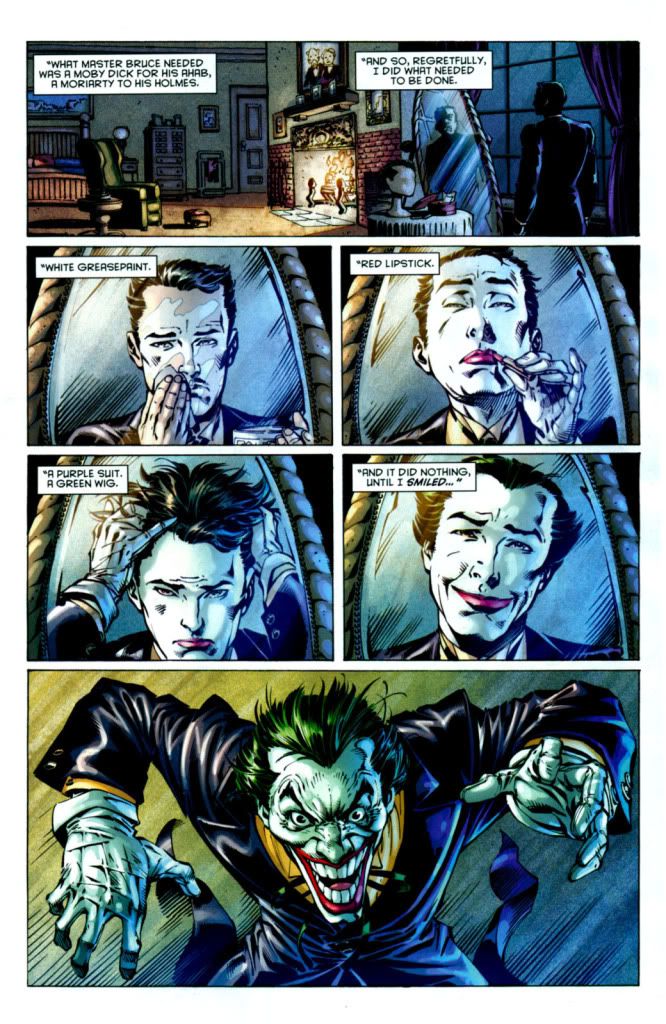
But eh, I'm expecting too much from Gaiman in using Two-Face in this slim two-issue story. Personally, I thought Whatever Happened to the Caped Crusader? was an odd, flawed, neat story that could have been great if it has been at least an issue or two longer, so that we could have really seen the reactions of all the characters rather than just a couple panels from about a dozen of them, alongside a bizarre story where Alfred is the Joker for some reason. Really, the extended subplot stories pale in comparison to simple character moments like Clayface's short, moving eulogy for Batman, and I would have loved to have seen more of that side of Two-Face.
Meh. Forget it, Hef: it's Gaimantown.
—Neil Gaiman, from a July 2009 interview with Wired.com.
... Sighhhh.
As you can imagine, that's a quote which has stuck in my craw for two years now. Mainly because I’m still not sure if Gaiman is ignorantly wrong, or simply speaking a brutal truth.
Look, god knows that *I* wanted (and still want) to see that movie, and I'm sure many/most of you would too, by simple virtue that you're reading this blog. By the way, I appreciate that If it weren't for your readership, comments, and discussion, I would have given up on this long ago. Hell, I certainly wouldn't have started About_Faces in the first place if I hadn't thought that Harvey was severely lacking in terms of having a devoted fandom.
Maybe that's all the more reason why Gaiman's words sting, and make me feel defeated as someone who loves the character on a deeply personal level as a fan, not just as someone who's been writing his own epic Harvey Dent origin whatever dealie. Maybe Gaiman's right in that most fans don't actively want to see the "ultimate Two-Face" movie (or comic, or animated episode, or novel, or whatever), but so what? That doesn't negate the fact that Harvey is a great character, even if so many of his stories are subpar.
When it comes to the Big Two comics, I've always maintained that There Are No Bad Characters, Just Bad Writers. While Harvey may be a rather difficult character to write well (for reasons which I explored in an earlier post after reading Chris Sims' thoughtful take on Harvey), he's still a character who endures by his iconic look alone, with the added bonus factors like the coin-flipping gimmick and his tragic origin. Even if Two-Face isn't a popularly-loved figure, he's still popularly-known.
For that alone, he transcends his own stories in the minds of fans and creators, and thus, I'd argue that they'd at least be open and receptive to an "ultimate Two-Face story" which takes the Harvey Dent they already know and spins him in a whole new light, while still holding true to the core of the character. Hell, we've already seen that happen with stories like Eye of the Beholder, Batman: The Animated Series, The Long Halloween, and The Dark Knight, all of which have proven to be definitive takes on Two-Face for certain fans, who judge all other appearances by those core stories.
In fact, Gaiman actually describes exactly what I'm talking about in the full context of the quote:
"The great thing about Batman and Superman, in truth, is that they are literally transcendent. They are better than most of the stories they are in. That’s jut Sturgeon’s Law: '90 percent of everything is crap.' Can you imagine how many thousands, or millions, of words have been written on Batman? Try to read them and you’re looking at 100,000 pages, perhaps a million, and you can assume that 90 percent of it is crap. Yet the 10 percent, and even better the 1 percent of that 10 perfect, is absolutely glorious. That pays for everything...
... it’s something that is missed when they’re made into movies. Marvel Comics has been much more successful than DC Comics, although DC got it right with The Dark Knight. With movies, you want that transcendent 10 percent, that mythology. The Iron Man movie fascinated me. It took a character [at the top of Marvel Comics'] second division, and did him right, so right that everyone goes, "This is why we love Iron Man." The joy of The Dark Knight movie is, 'This is what a Joker story should be like.' No one wants to see the ultimate Two-Face movie."
Reading that whole thing, I guess what really annoys me is that I'm not sure what he really means. What does Two-Face--and the lack of interest for him--have to do with Gaiman's point? How does it illustrate what he's saying? Maybe I'm not accurately or proportionately responding to what was just an off-handed comment by Gaiman, but regardless of what he meant, it's been bugging the hell out of me for years now. I'm just glad to finally have this community where I can figure out WHY it's bugged me so much with other people who'll actually CARE.
But eh, I shouldn't be surprised that Gaiman apprently doesn't think much of Harvey, since the way he used the character in Batman: Whatever Happened to the Caped Crusader? displays a fun-but-pretty-superficial understanding of the character:
For those who don't know the story, Harvey's heading to Batman's funeral, and therefore I take the fact that Harvey gives the coin away as a symbol that he's quitting being Two-Face. On a character level, if there's no Batman, there's no point. On a meta level, it's symbolic of how all things are coming to an end with these characters as they eulogize Batman. Both friends and enemies are present, and you can clearly see that Harvey falls into the latter category from his seating placement at the funeral:
I don't suppose Harvey could sit in the middle, but damn, what does it say when Chuck Dixon and Greg Land get it better than Gaiman and Andy Kubert?
Thing is, earlier in the story, Kirk Langstrom (Man-Bat) shows up, and he is told that he can sit on either aisle. It's cute, but personally, I think that just means that Gaiman is a child of 70's Batman comics, where Two-Face was pretty much just a straight villain (albeit one with a tragic past), whereas Langstrom was the ally/monster character.
But eh, I'm expecting too much from Gaiman in using Two-Face in this slim two-issue story. Personally, I thought Whatever Happened to the Caped Crusader? was an odd, flawed, neat story that could have been great if it has been at least an issue or two longer, so that we could have really seen the reactions of all the characters rather than just a couple panels from about a dozen of them, alongside a bizarre story where Alfred is the Joker for some reason. Really, the extended subplot stories pale in comparison to simple character moments like Clayface's short, moving eulogy for Batman, and I would have loved to have seen more of that side of Two-Face.
Meh. Forget it, Hef: it's Gaimantown.