![[personal profile]](https://www.dreamwidth.org/img/silk/identity/user.png) about_faces
about_facesHarvey Dent's final appearance in the DCAU (and Two-Face's first appearance in The Batman Adventures comics) coincides with the brief, remarkable tenure of new series artist Mike Parobeck. Taking over from Ty Templeton and joined by original inker (and all-around all-star of Batman comics) Rick Burchett, Parobeck's pencils helped shape The Batman Adventures from a fun tie-in kid's comic into a series which felt every bit as sweeping, cinematic, and animated as the animated series itself.
For a perfect example, let's first take a quick look at issue #9, The Little Red Book. While this was Parobeck's third issue of The Batman Adventures, it was the first to really showcase his considerable talents for action. Considering that Kelley Puckett's story this time around was rather paper-thin, Parobeck's art really was the whole point... well, except for a cameo from Harvey, but who cares about that sort of thing other than me? Answer: hopefully some of you too!
The "little red book" in question is the MacGuffin which drives this story's action, as Batman proceeds to chase down some nondescript mobsters in pursuit of the book. It's only when the book is seemingly destroyed that we learn its significance:

It's kind of funny that Gordon--not Harvey Dent--is the frustrated lawman lamenting the unfairness of the situation. Was Puckett purposely going for irony, or did he just miss an opportunity to retroactively establish some semblance of Harvey's frustration and desire for justice?
Suspecting that Thorne has a second copy of the book, Batman breaks into Thorne's heavily-guarded mansion to strong-arm the mobster. Hey, evidence obtained by a vigilante committing breaking and entering totally won't be problematic in court, right? A huge fight breaks out, Thorne gets injured, and as henchmen speed off with the real book, Batman peruses them in a sequence which shows off Parobeck and Burchett's considerable strengths:

I suspect that if this book came out in a different time, I imagine that stories like this would have gotten collected in books like The Greatest Batman Stories of All Time alongside the standalone Bronze Age stories of guys like Walt Simonson, Marshall Rogers, and Alex Toth. As it was, Parobeck was an artist's artist, and to this day, I still talk to artists who speak of Parobeck's work with glowing, bittersweet praise. Tragically, Parobeck died at 30 from complications with diabetes, passing away just as his star was starting to rise. I urge you to read great tribute to his all-too-short life and career over here. It reads like an amazing episode of Behind the Music, but with comics. It's truly sad that Parobeck isn't more well-known among fandom today, but that has a lot to do with the fact that most of his work hasn't been reprinted, including TBA, the majority of which featured his artwork. All the more reason I wish I had the time to post about every single issue of the DCAU comics. Anyway, sorry to be a Debbie Downer, folks. On with the story!
This story ends with Batman triumphantly retrieving the book, and the next time we see it, it's in the possession of Harvey in this one-page cameo, his very last sane appearance in the DCAU:

Hahaha, it's a happy ending! Well, except for the utter futility of finally obtaining the one thing that could finally bring down Thorne, only to have it rendered useless by a corrupted jury, thus once again making Thorne seem invincible against even the best efforts of Gotham's three greatest lawmen. That's pretty goddamn depressing. But hey, they mildly inconvenienced and momentarily embarrassed Thorne, so that's... progress? Well, take your victories where you can, I guess. Harvey, for one, certainly seems happy enough, his attitude here in keeping with the smugly delighted Harvey Dent of Batman: Year One. I suppose the next best thing to defeating evil is pissing it off, so even if Harvey can't get a conviction, he can at least spend an afternoon going LOL U MAD THORNE?
I should mention that this issue came out in the summer of 1993, almost a year after the Two-Face origin episode (which was also Thorne's first appearance) went on the air. Since it's likely that Kelley Puckett wrote this issue after seeing the episode himself, I have to wonder if this story was intended to give a bit of history between Thorne and Harvey, who had previously been written as a happy-go-lucky dope more interested in press conferences and hot redheads than in tackling organized crime.
As such, this issue was the very first to actually flesh out characters and events from B:TAS. Up to this point, Puckett's stories in TBA were great fun but less than supplemental, especially since his takes on Joker, the Penguin, and Croc didn't quite match up with their animated counterparts. I strongly suspect that Puckett was working from the original TAS Writer's Bible, which contained many huge differences from the produced episodes. After Little Red Book, Puckett and Parobeck's stories not only better matched the show, but they also followed up on events in the form of character development and sequels.
Which brings us to TBA #22, which stars... well, who else?

Full disclosure: right up until I reread this issue for this review, I used to think that The Batman Adventures #22, "Good Face, Bad Face," was the weakest of the major Two-Face appearances in all of the TAS comics. But then, generally speaking, I always viewed Puckett's stories over the majority of these stories was vastly inferior compared to the work of Ty Templeton and Paul Dini. To me, Puckett's work was fluff, comprised of big empty panels with one or two lines of dialogue with little in the way of story or character depth, mainly serving as a template for Parobeck's wonderful art.
Or so I thought. It was only as I was forced to sit down and study his work like the series finale for TBA with Hugo Strange that I truly came to understand the subtle talents of Puckett's stories. What I took for simplicity, I now see as something that--at its best--was more akin to graceful superhero haiku. As such, I hope that I can be forgiven for posting a bit more than the usual scan limit of 1/3rd an issue. If anyone has a problem with this, let me know and I'll trim or delete accordingly.
While I used to see Good Face, Bad Face, as a blandly standard Two-Face story (Harvey's committing crimes! Batman wants to save his friend! Two-Face breaks down without his coin and goes to jail! Repeat!), I was amazed upon to discover that it actually has a compelling insight into the nature of Harvey Dent's insanity, and what the coin-flipping truly represents. In keeping with the ending of Two-Face, Part 2, it's tragic but not without hope, however distant.
The story opens at Arkham Asylum, as inmate Harvey Dent proceeds to knock out a guard, steal his uniform, and make his escape. While wearing the guard's baseball cap (CUNNING DISGUISE ACHIEVED, NO ONE WILL EVER KNOW), Harvey hears a familiar voice call after him from within one of the cells.


Again, there's Joker alluding to history with Harvey. Furthermore, I just realized that the first three major Harvey appearances in the TAS comics involved the Joker in some capacity, which might just shed some new light on the tragic events about to transpire in the next post. For now, let's savor Harvey's brief moment of intimidating the Joker.
As with the previous issue, the art by Parobeck and Burchett--along with Rick Taylor's coloring--really captured the lush feeling of the animated show from those first few seasons. Throw in Richard Starkings' art deco lettering (which he'd use again to great mood-setting effect in The Long Halloween, which in retrospect really feels like a darker, more violent, more poorly-written TBA story), and the result feels like a whole episode on the page even without Puckett's writing.
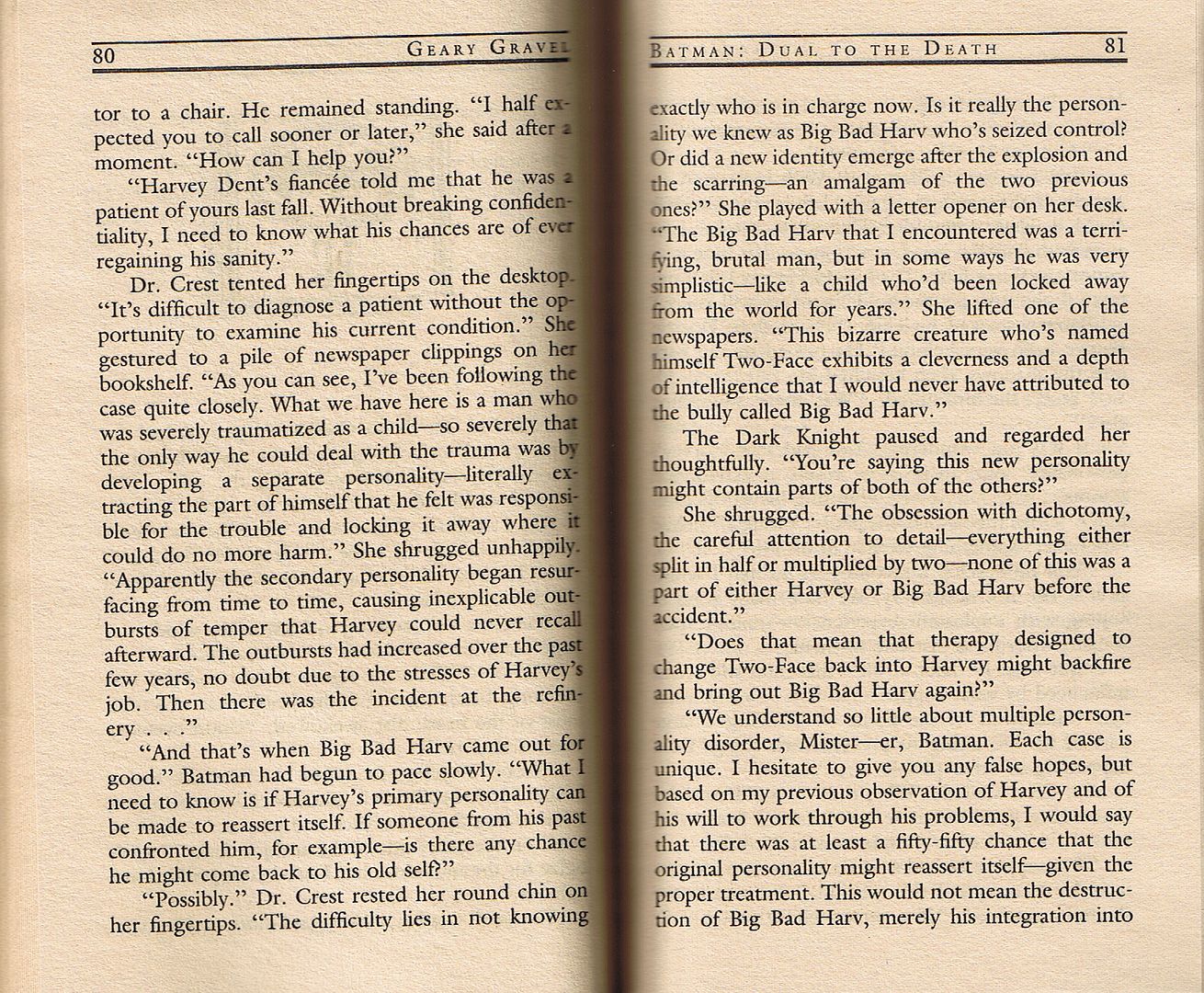
As I said before, Puckett's stories addressed some areas that were left out of B:TAS, and in this issue's case, the focus is on the nature of Harvey's insanity. While Two-Face, Part I established some explanation as to Harvey's warring mental state, we were given no insight as to what exactly was going on once he properly became Two-Face. While the novelization Dual to the Death offered its own theories, those shouldn't necessarily be taken as canon. Far as we're concerned, there's still no explanation for what Two-Face really represents, nor why he's so fixated on the coin, nor why he needs said coin to make decisions.
Those are precisely the questions which Puckett decides to explore:


The use of a reel-to-reel tape player reminds me of just how much I loved that TAS' "Dark Deco" Gotham was a timeless mixture of retro and modern, where Batman could use a supercomputer but still watch movies on newsreel in his den. I'll always prefer that kind of mixed fantasy noir setting over the current comics trend by writers such as Scott Snyder, who love coming up with new high-tech gadgets and forensic techniques, as if Batman were both James Bond and Q with a good dash of Gil Grissom.
Back to Harvey. So instead of Two-Face being an all-new third personality incorporating both Harvey and Big Bad Harv, Puckett looks at the same evidence (namely, that Big Bad Harv has little in common with Two-Face save for the voice) and instead sees it as a case of Hyde gradually subsuming Jekyll by incorporating (feeding off of?) the once-dominant side until only Hyde remains.![[livejournal.com profile]](https://www.dreamwidth.org/img/external/lj-userinfo.gif) deadwalrus has previously discussed this sort of thing with Jekyll and Hyde, and Alan Moore put that theory to compellingly creepy test in League of Extraordinary Gentlemen. Again, I don't know if any of this holds a drop of water in terms of real-life mental illness, but Harvey's illness has always been more literary than literal anyway.
deadwalrus has previously discussed this sort of thing with Jekyll and Hyde, and Alan Moore put that theory to compellingly creepy test in League of Extraordinary Gentlemen. Again, I don't know if any of this holds a drop of water in terms of real-life mental illness, but Harvey's illness has always been more literary than literal anyway.
Back to the story: Two-Face orchestrates a jailbreak to bust out Jimmy McSorley, the top lieutenant of the O'Reilly crime family. As with Min and Max, Jimmy was once prosecuted by D.A. Harvey Dent, and now the man who put Jimmy away has shown up to offer the mobster a choice: stay in jail, or join up with his own gang. Batman soon discovers that Harvey's snatching up mobsters as if they were Pokémon.

... is, of course, Stonegate Penitentiary. Which still sounds weird to even type. It's BLACKgate, ding-dang it! /analretentiveDCfanboy
Also, do you notice anything funny about those mobsters' names?
One of the biggest problems with any Two-Face origin is that none have convincingly explained why he became a crime boss. Two-Face as a vigilante, sure, makes perfect sense. As a criminal seeking revenge on the people who ruined his life? Totally. But as an out-and-out mobster and gang lord who seeks power and money above everything else? Comes out of bloody nowhere. And no, "well, he's EVIL now!" doesn't cut it as a motivation.
B:TAS suffers from this same problem. By the time we see Two-Face again in his next major appearances--The Strange Secret of Bruce Wayne,Almost Got 'Im and Shadow of the Bat--he's already firmly established as a professional criminal with his own henchmen, the kind of guy who pals around with Penguin and the Joker. While Puckett isn't coming up with any explanation as to why that happened, he's at least good enough to show us how. Just as Two-Face is (possibly) overtaking Harvey, he's doing the same with Thorne's criminal empire, and using Harvey's own past legal victories in the process.
God, think about that: Two-Face is systematically absorbing and destroying everything that is Harvey Dent not just in mind and body, but legacy as well. For Two-Face, who loathes everything about Harvey, maybe that's motivation enough.
Of course, there is a practical flaw with Two-Face's plan: namely, hiring an entire gang of hardened criminals who all have a reason to hate your guts. But I think Puckett already has that problem in mind, and addresses it by having Harvey score brownie points with the cons by breaking them out of prison... and even giving them a special treat in the process:

Yeah, that might help curry some favor from the prospective new help.
Of course, Batman thwarts the robbery with the help of Commissioner Gordon, who warns, "Just don't do anything stupid. He's not Harvey anymore, understand?" Gordon--like the Robins, even Alfred to an extent, and Two-Face himself--all see Harvey as a lost cause, nothing more than a criminal who just needs to be taken down. When it comes to saving Harvey Dent, Batman's quest increasingly seems downright quixotic. But Batman doesn't listen. He can't bring himself to believe that they're right. Nobody embodies "I believe in Harvey Dent" more strongly nor more poignantly than Batman.
Which brings us to their big rooftop confrontation at the end, which is where Puckett finally hits us with his big theory about Two-Face:


Before we address this theory and its outcome, let's get the nitpick out of the way: the coin isn't two-headed! It's a normal coin (a silver coin which seems to have the Lincoln Memorial behind it; a silver dollar/penny?), with the face side scratched up. Unless it's an artist's error, we're led to conclude that this is a different coin, and something Batman will say on the next page will reinforce that possibility:

So yeah, if the coin's part of his therapy, it stands to reason that the coin Harvey was using here wasn't the original. In fact, maybe there never was a One True Coin. If he loses one, he just scars up a new one, so all that matters is that the heads side is defaced, so to speak. All the same, keep in mind that some of the later issues written by Ty Templeton won't quite mesh with this theory, instead suggesting the possibility that Harvey needs (or at least prefers) his one specific coin.
Okay, okay, enough nitpicking about details. Let's finally look at Puckett's theory!
This is one of the most interesting ideas about Two-Face and why he flips the coin. While the coin is often seen as a crutch or a hypocritical way to absolve himself of responsibility, I've often wondered if the coin instead is the only thing keeping the bad side in check. It maintains the balance, and in so doing, preserves at least some of Harvey's humanity. That would be all the more reason why the doctors would give Harvey a coin for therapy: without the coin, Harvey may be rendered paralyzed and impotent... or maybe, as Two-Face gets stronger, maybe Big Bad Harv will overtake Harvey Dent completely.
But is this theory true? Batman "had to know" if Harvey was still in there, so did Harvey's breakdown prove him right? It's not like the end of Two-Face, Part II hadn't already shown what would happen to Two-Face without the coin, so what was Batman hoping to prove this time? That Harvey would be unable to kill Batman point-blank even if given the opportunity? That doesn't necessarily prove Batman's theory. Harvey never takes over for a moment and says, "Thank you for believing in me, Batman, I'm trying my best!"
So I'm not sure if the results were conclusive, but until further evidence comes along, it's a theory I'd certainly like to be true. But even if it is, Batman's still forgetting the most ironic and tragic aspect of all: Two-Face's actions ALREADY define Harvey Dent for everyone except Batman. If Batman's theory is in fact wrong, then he's locked in a quixotic quest to save a dead man, but if Harvey is indeed still struggling, it's a lonely battle which is going largely unacknowledged. I don't know which possibility is more tragic.
Either way, it makes Batman's belief in Harvey more vital than ever, because at least one person is still cheering on the good man trapped within the monster... even if the monster's already won. And when while subseuquent episodes suggest that Harvey IS still in there, that status is always subject to change. As if Bruce's own belief in Harvey Dent.
Purchase info: As I said before, The Batman Adventures is largely out of print, but the first twelve issues have been collected here and here (which is the one with #9, Little Red Book, if you want to read the whole thing). The first twelve can also be found up for digital purchase on DC's Comixology app for .99¢ each, including Little Red Book. As for the rest, let's hope that DC someday finally puts the rest of TBA in print.
For a perfect example, let's first take a quick look at issue #9, The Little Red Book. While this was Parobeck's third issue of The Batman Adventures, it was the first to really showcase his considerable talents for action. Considering that Kelley Puckett's story this time around was rather paper-thin, Parobeck's art really was the whole point... well, except for a cameo from Harvey, but who cares about that sort of thing other than me? Answer: hopefully some of you too!
The "little red book" in question is the MacGuffin which drives this story's action, as Batman proceeds to chase down some nondescript mobsters in pursuit of the book. It's only when the book is seemingly destroyed that we learn its significance:
It's kind of funny that Gordon--not Harvey Dent--is the frustrated lawman lamenting the unfairness of the situation. Was Puckett purposely going for irony, or did he just miss an opportunity to retroactively establish some semblance of Harvey's frustration and desire for justice?
Suspecting that Thorne has a second copy of the book, Batman breaks into Thorne's heavily-guarded mansion to strong-arm the mobster. Hey, evidence obtained by a vigilante committing breaking and entering totally won't be problematic in court, right? A huge fight breaks out, Thorne gets injured, and as henchmen speed off with the real book, Batman peruses them in a sequence which shows off Parobeck and Burchett's considerable strengths:
I suspect that if this book came out in a different time, I imagine that stories like this would have gotten collected in books like The Greatest Batman Stories of All Time alongside the standalone Bronze Age stories of guys like Walt Simonson, Marshall Rogers, and Alex Toth. As it was, Parobeck was an artist's artist, and to this day, I still talk to artists who speak of Parobeck's work with glowing, bittersweet praise. Tragically, Parobeck died at 30 from complications with diabetes, passing away just as his star was starting to rise. I urge you to read great tribute to his all-too-short life and career over here. It reads like an amazing episode of Behind the Music, but with comics. It's truly sad that Parobeck isn't more well-known among fandom today, but that has a lot to do with the fact that most of his work hasn't been reprinted, including TBA, the majority of which featured his artwork. All the more reason I wish I had the time to post about every single issue of the DCAU comics. Anyway, sorry to be a Debbie Downer, folks. On with the story!
This story ends with Batman triumphantly retrieving the book, and the next time we see it, it's in the possession of Harvey in this one-page cameo, his very last sane appearance in the DCAU:
Hahaha, it's a happy ending! Well, except for the utter futility of finally obtaining the one thing that could finally bring down Thorne, only to have it rendered useless by a corrupted jury, thus once again making Thorne seem invincible against even the best efforts of Gotham's three greatest lawmen. That's pretty goddamn depressing. But hey, they mildly inconvenienced and momentarily embarrassed Thorne, so that's... progress? Well, take your victories where you can, I guess. Harvey, for one, certainly seems happy enough, his attitude here in keeping with the smugly delighted Harvey Dent of Batman: Year One. I suppose the next best thing to defeating evil is pissing it off, so even if Harvey can't get a conviction, he can at least spend an afternoon going LOL U MAD THORNE?
I should mention that this issue came out in the summer of 1993, almost a year after the Two-Face origin episode (which was also Thorne's first appearance) went on the air. Since it's likely that Kelley Puckett wrote this issue after seeing the episode himself, I have to wonder if this story was intended to give a bit of history between Thorne and Harvey, who had previously been written as a happy-go-lucky dope more interested in press conferences and hot redheads than in tackling organized crime.
As such, this issue was the very first to actually flesh out characters and events from B:TAS. Up to this point, Puckett's stories in TBA were great fun but less than supplemental, especially since his takes on Joker, the Penguin, and Croc didn't quite match up with their animated counterparts. I strongly suspect that Puckett was working from the original TAS Writer's Bible, which contained many huge differences from the produced episodes. After Little Red Book, Puckett and Parobeck's stories not only better matched the show, but they also followed up on events in the form of character development and sequels.
Which brings us to TBA #22, which stars... well, who else?
Full disclosure: right up until I reread this issue for this review, I used to think that The Batman Adventures #22, "Good Face, Bad Face," was the weakest of the major Two-Face appearances in all of the TAS comics. But then, generally speaking, I always viewed Puckett's stories over the majority of these stories was vastly inferior compared to the work of Ty Templeton and Paul Dini. To me, Puckett's work was fluff, comprised of big empty panels with one or two lines of dialogue with little in the way of story or character depth, mainly serving as a template for Parobeck's wonderful art.
Or so I thought. It was only as I was forced to sit down and study his work like the series finale for TBA with Hugo Strange that I truly came to understand the subtle talents of Puckett's stories. What I took for simplicity, I now see as something that--at its best--was more akin to graceful superhero haiku. As such, I hope that I can be forgiven for posting a bit more than the usual scan limit of 1/3rd an issue. If anyone has a problem with this, let me know and I'll trim or delete accordingly.
While I used to see Good Face, Bad Face, as a blandly standard Two-Face story (Harvey's committing crimes! Batman wants to save his friend! Two-Face breaks down without his coin and goes to jail! Repeat!), I was amazed upon to discover that it actually has a compelling insight into the nature of Harvey Dent's insanity, and what the coin-flipping truly represents. In keeping with the ending of Two-Face, Part 2, it's tragic but not without hope, however distant.
The story opens at Arkham Asylum, as inmate Harvey Dent proceeds to knock out a guard, steal his uniform, and make his escape. While wearing the guard's baseball cap (CUNNING DISGUISE ACHIEVED, NO ONE WILL EVER KNOW), Harvey hears a familiar voice call after him from within one of the cells.
Again, there's Joker alluding to history with Harvey. Furthermore, I just realized that the first three major Harvey appearances in the TAS comics involved the Joker in some capacity, which might just shed some new light on the tragic events about to transpire in the next post. For now, let's savor Harvey's brief moment of intimidating the Joker.
As with the previous issue, the art by Parobeck and Burchett--along with Rick Taylor's coloring--really captured the lush feeling of the animated show from those first few seasons. Throw in Richard Starkings' art deco lettering (which he'd use again to great mood-setting effect in The Long Halloween, which in retrospect really feels like a darker, more violent, more poorly-written TBA story), and the result feels like a whole episode on the page even without Puckett's writing.
As I said before, Puckett's stories addressed some areas that were left out of B:TAS, and in this issue's case, the focus is on the nature of Harvey's insanity. While Two-Face, Part I established some explanation as to Harvey's warring mental state, we were given no insight as to what exactly was going on once he properly became Two-Face. While the novelization Dual to the Death offered its own theories, those shouldn't necessarily be taken as canon. Far as we're concerned, there's still no explanation for what Two-Face really represents, nor why he's so fixated on the coin, nor why he needs said coin to make decisions.
Those are precisely the questions which Puckett decides to explore:
The use of a reel-to-reel tape player reminds me of just how much I loved that TAS' "Dark Deco" Gotham was a timeless mixture of retro and modern, where Batman could use a supercomputer but still watch movies on newsreel in his den. I'll always prefer that kind of mixed fantasy noir setting over the current comics trend by writers such as Scott Snyder, who love coming up with new high-tech gadgets and forensic techniques, as if Batman were both James Bond and Q with a good dash of Gil Grissom.
Back to Harvey. So instead of Two-Face being an all-new third personality incorporating both Harvey and Big Bad Harv, Puckett looks at the same evidence (namely, that Big Bad Harv has little in common with Two-Face save for the voice) and instead sees it as a case of Hyde gradually subsuming Jekyll by incorporating (feeding off of?) the once-dominant side until only Hyde remains.
deadwalrus has previously discussed this sort of thing with Jekyll and Hyde, and Alan Moore put that theory to compellingly creepy test in League of Extraordinary Gentlemen. Again, I don't know if any of this holds a drop of water in terms of real-life mental illness, but Harvey's illness has always been more literary than literal anyway. Back to the story: Two-Face orchestrates a jailbreak to bust out Jimmy McSorley, the top lieutenant of the O'Reilly crime family. As with Min and Max, Jimmy was once prosecuted by D.A. Harvey Dent, and now the man who put Jimmy away has shown up to offer the mobster a choice: stay in jail, or join up with his own gang. Batman soon discovers that Harvey's snatching up mobsters as if they were Pokémon.
... is, of course, Stonegate Penitentiary. Which still sounds weird to even type. It's BLACKgate, ding-dang it! /analretentiveDCfanboy
Also, do you notice anything funny about those mobsters' names?
One of the biggest problems with any Two-Face origin is that none have convincingly explained why he became a crime boss. Two-Face as a vigilante, sure, makes perfect sense. As a criminal seeking revenge on the people who ruined his life? Totally. But as an out-and-out mobster and gang lord who seeks power and money above everything else? Comes out of bloody nowhere. And no, "well, he's EVIL now!" doesn't cut it as a motivation.
B:TAS suffers from this same problem. By the time we see Two-Face again in his next major appearances--The Strange Secret of Bruce Wayne,Almost Got 'Im and Shadow of the Bat--he's already firmly established as a professional criminal with his own henchmen, the kind of guy who pals around with Penguin and the Joker. While Puckett isn't coming up with any explanation as to why that happened, he's at least good enough to show us how. Just as Two-Face is (possibly) overtaking Harvey, he's doing the same with Thorne's criminal empire, and using Harvey's own past legal victories in the process.
God, think about that: Two-Face is systematically absorbing and destroying everything that is Harvey Dent not just in mind and body, but legacy as well. For Two-Face, who loathes everything about Harvey, maybe that's motivation enough.
Of course, there is a practical flaw with Two-Face's plan: namely, hiring an entire gang of hardened criminals who all have a reason to hate your guts. But I think Puckett already has that problem in mind, and addresses it by having Harvey score brownie points with the cons by breaking them out of prison... and even giving them a special treat in the process:
Yeah, that might help curry some favor from the prospective new help.
Of course, Batman thwarts the robbery with the help of Commissioner Gordon, who warns, "Just don't do anything stupid. He's not Harvey anymore, understand?" Gordon--like the Robins, even Alfred to an extent, and Two-Face himself--all see Harvey as a lost cause, nothing more than a criminal who just needs to be taken down. When it comes to saving Harvey Dent, Batman's quest increasingly seems downright quixotic. But Batman doesn't listen. He can't bring himself to believe that they're right. Nobody embodies "I believe in Harvey Dent" more strongly nor more poignantly than Batman.
Which brings us to their big rooftop confrontation at the end, which is where Puckett finally hits us with his big theory about Two-Face:
Before we address this theory and its outcome, let's get the nitpick out of the way: the coin isn't two-headed! It's a normal coin (a silver coin which seems to have the Lincoln Memorial behind it; a silver dollar/penny?), with the face side scratched up. Unless it's an artist's error, we're led to conclude that this is a different coin, and something Batman will say on the next page will reinforce that possibility:
So yeah, if the coin's part of his therapy, it stands to reason that the coin Harvey was using here wasn't the original. In fact, maybe there never was a One True Coin. If he loses one, he just scars up a new one, so all that matters is that the heads side is defaced, so to speak. All the same, keep in mind that some of the later issues written by Ty Templeton won't quite mesh with this theory, instead suggesting the possibility that Harvey needs (or at least prefers) his one specific coin.
Okay, okay, enough nitpicking about details. Let's finally look at Puckett's theory!
This is one of the most interesting ideas about Two-Face and why he flips the coin. While the coin is often seen as a crutch or a hypocritical way to absolve himself of responsibility, I've often wondered if the coin instead is the only thing keeping the bad side in check. It maintains the balance, and in so doing, preserves at least some of Harvey's humanity. That would be all the more reason why the doctors would give Harvey a coin for therapy: without the coin, Harvey may be rendered paralyzed and impotent... or maybe, as Two-Face gets stronger, maybe Big Bad Harv will overtake Harvey Dent completely.
But is this theory true? Batman "had to know" if Harvey was still in there, so did Harvey's breakdown prove him right? It's not like the end of Two-Face, Part II hadn't already shown what would happen to Two-Face without the coin, so what was Batman hoping to prove this time? That Harvey would be unable to kill Batman point-blank even if given the opportunity? That doesn't necessarily prove Batman's theory. Harvey never takes over for a moment and says, "Thank you for believing in me, Batman, I'm trying my best!"
So I'm not sure if the results were conclusive, but until further evidence comes along, it's a theory I'd certainly like to be true. But even if it is, Batman's still forgetting the most ironic and tragic aspect of all: Two-Face's actions ALREADY define Harvey Dent for everyone except Batman. If Batman's theory is in fact wrong, then he's locked in a quixotic quest to save a dead man, but if Harvey is indeed still struggling, it's a lonely battle which is going largely unacknowledged. I don't know which possibility is more tragic.
Either way, it makes Batman's belief in Harvey more vital than ever, because at least one person is still cheering on the good man trapped within the monster... even if the monster's already won. And when while subseuquent episodes suggest that Harvey IS still in there, that status is always subject to change. As if Bruce's own belief in Harvey Dent.
Purchase info: As I said before, The Batman Adventures is largely out of print, but the first twelve issues have been collected here and here (which is the one with #9, Little Red Book, if you want to read the whole thing). The first twelve can also be found up for digital purchase on DC's Comixology app for .99¢ each, including Little Red Book. As for the rest, let's hope that DC someday finally puts the rest of TBA in print.